Worktop Drainage Grooves: Are They Worth It? Well I recently posted a reel on Instagram saying that drainage grooves in worktops are more decorative than functional. I knew it might ruffle a few feathers, but the response told me a lot of you have been thinking the same thing. So here’s the longer version.
If you’re planning a new kitchen with a stone, quartz or solid surface worktop, there’s a good chance someone will ask if you want drainer grooves cut next to the sink. They look smart in a showroom. They photograph well. But after years of designing kitchens and hearing from clients who live with them, my honest view is that most people would be better off without them. Further discussion can be found on Houzz.
What are drainage grooves?
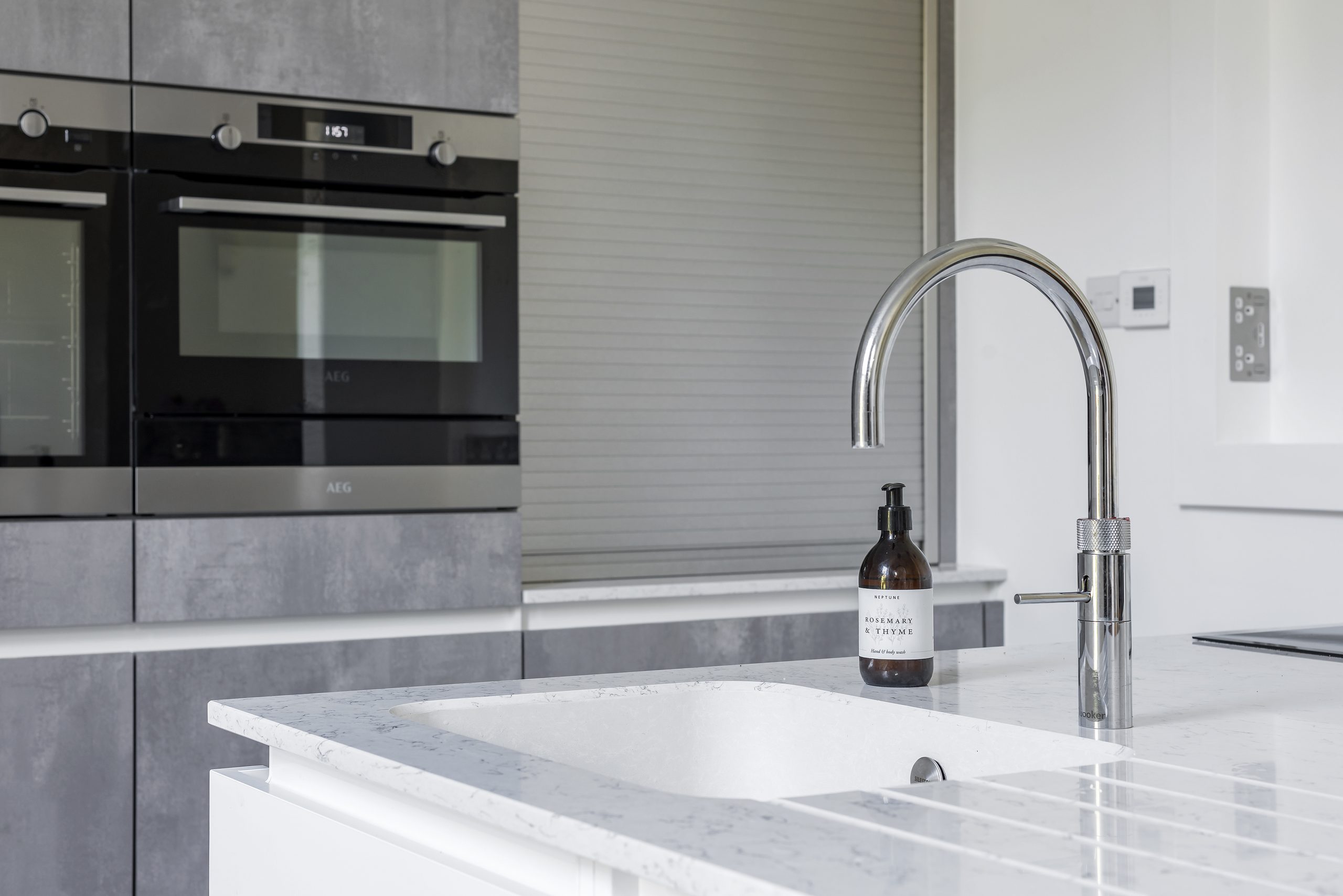
Drainage grooves (sometimes called drainer grooves or drainer flutes) are a series of shallow channels routed into the worktop beside an undermount or Belfast sink. The idea is simple: you put wet pans and glasses on them, and the water runs along the grooves and back into the sink.
In theory, it’s a built-in draining board without the clutter. In practice, it doesn’t quite work like that.
Why they don’t really drain
For water to drain, it needs a proper fall. Most drainage grooves are cut very shallow, and the fall towards the sink is minimal, so the water has nowhere much to go. It just sits in the channels.
The other thing to know is that a pan or a plate sitting flat on the grooves blocks a lot of the water underneath it. You lift it up later and there’s a little puddle in each groove. A glass turned upside down does the same.
So you end up doing what you’d do anyway: grabbing a tea towel and wiping it all down. At that point, the grooves haven’t saved you any effort at all.
The cleaning and upkeep reality
This is the bit nobody mentions when they’re selling them to you.
Standing water in narrow channels means limescale, and in hard water areas like ours around Bath and Bristol, it builds up quickly. Add in food bits, washing-up liquid residue and the odd tea stain, and the grooves need regular attention to keep them looking good.
A quick wipe across a flat worktop takes seconds. Getting into each groove properly takes a bit more effort, and if you let it slide, the grooves are the first place you’ll notice it. Plenty of people end up putting a drying mat or rack over the top of them anyway, which rather defeats the point.
The cost, and what it does to your worktop
Drainage grooves aren’t free. They’re an extra machining job for your worktop fabricator, so they add to the price of your worktops. It’s not usually a huge amount, but it’s money spent on something that, for most households, doesn’t earn its keep.
They’re also permanent. Once they’re cut, that section of worktop is committed to being a drainer. You lose a flat, usable bit of surface right next to the sink, which is often prime prep space. If you change your mind in a few years, there’s no going back.
It’s also worth knowing that grooves remove material from the slab. A good fabricator will know what your chosen material can take, but it’s one more thing to think about, especially on thinner worktops.
When grooves can make sense
I’m not saying never. There are times they work well.
- If you love the look. They do add a nice detail beside a sink, and if that’s what you want, that’s a perfectly good reason. Just go in knowing they’re mostly there for looks.
- If you hand wash a lot and have no dishwasher. Then a drainer area gets used every day, and grooves can be a tidier option than a plastic drainer.
- If it’s done properly, with a recessed drainer. This is where the whole drainer area is cut slightly lower than the rest of the worktop, with a genuine fall back into the sink. It drains far better than a few shallow grooves, though it costs more and needs a skilled fabricator.
What I’d suggest instead
If you want somewhere to drain the odd pan or wine glass, there are simpler options that do the job better and keep your worktop flat and flexible:
- An over-sink roll-up rack. It sits across the sink, drips straight into the bowl, and rolls away into a drawer when you’re done.
- A silicone drying mat. Cheap, easy to wash, and you can put it away when you have guests.
- A sink with a built-in drainer. If you really want a dedicated draining area, an inset sink with its own drainer will drain properly because it’s designed to.
- A one and a half bowl sink. The smaller bowl makes a handy place to leave things to drip without taking up any worktop.
- A good dishwasher. For most households, this is where the vast majority of washing up goes anyway, so it’s worth thinking about how much draining you actually do.
My honest verdict
Drainage grooves are a design feature, not a practical one. If you like how they look and you’re happy to keep them clean, go for it. But if you’re choosing them because you think they’ll make washing up easier, I’d think again. A flat run of worktop beside the sink is usually more useful day to day.
This is exactly the sort of thing I talk through with clients during the design stage. It’s not about what looks good in a brochure; it’s about how you actually use your kitchen.
If you’re thinking about a new kitchen in Bristol or Bath, I’d love to hear about your project – get in touch to book your free design appointment.
👉 Book a free design appointment
Have a good week!
Vicky